
If you ship a mobile app, you have probably tried in-app feedback at some point. A simple prompt after onboarding, a thumbs-up after a purchase, maybe an NPS question once a quarter. You collect a handful of responses, read them, and then nothing much changes.
That is the trap. In-app feedback gets evaluated as a one-off tactic, when its real value only shows up over time. The first survey gives you a single data point. The tenth survey, run as part of how you ship, gives you a picture. The hundredth survey, sitting next to a year of historical responses, becomes infrastructure you would not give up.
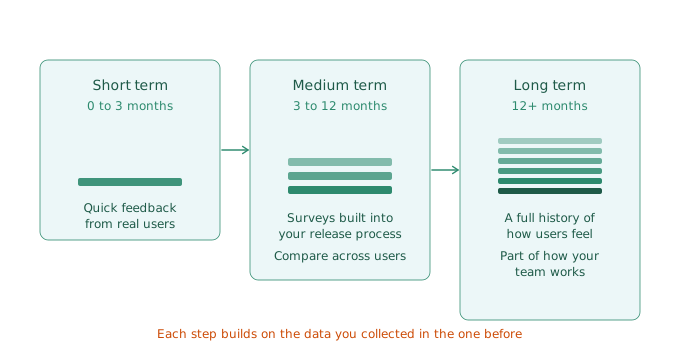
This post is about that compounding effect. Three time horizons, what each one delivers, and why this matters for churn.
The starting point: App Store reviews and analytics are not enough
Most mobile development teams already have two sources of user signal. Neither is sufficient on its own.
App Store reviews skew toward extremes. Academic research on Apple’s App Store has documented a clear negativity bias in how reviews are written and perceived, with users disproportionately leaving feedback when something goes very right or very wrong. The middle is silent. You hear from the angry one-star reviewer who could not log in, and the delighted five-star fan who loved the new feature. You almost never hear from the 80% in between, who use your app, find it fine, and quietly drift away three months later.
Analytics tells you the opposite half of the picture. You know exactly what users do: which screens they visit, which features they tap, where they drop off. You have no idea why. A funnel chart cannot tell you whether users abandoned checkout because the form was confusing, because they got distracted, or because they decided your app was not worth paying for.
In-app feedback is the missing third leg. It catches the silent middle, and it answers the why behind the what. But to actually move the needle, it has to compound.
Short term: fast signal in the first weeks
In the first weeks after integrating in-app surveys, you get something you could not get before. Direct, in-context user voice from people who are still using your app right now.
A targeted survey after a specific flow, like checkout abandonment, onboarding completion, or feature discovery, surfaces friction within days. Even a handful of qualitative responses can validate or kill a roadmap assumption that would otherwise take a quarter of A/B testing to nail down.
This matters because mobile retention is brutal. Industry data shows that on iOS, average day-one retention is around 24%, dropping to under 4% by day 30. Most teams are losing the majority of their users in the first month, and most of those users leave without ever telling you why. Catching even a small slice of that “why” early shifts your roadmap toward problems that actually drive churn.
The short-term ROI is what gets in-app feedback through the door. It is not yet what makes it stick.
Medium term: from one-off surveys to a feedback strategy
This is where in-app feedback shifts from “a tool we tried” to “part of how we ship.”
Around the three-to-twelve-month mark, surveys stop being individual experiments and start being a standard part of feature releases. Pre-launch sentiment checks. Post-launch validation. Periodic NPS-style measurements you can compare across releases. The infrastructure that felt like overkill at month one (targeting rules, repeat policies, completion history) becomes genuinely useful, because you are now running surveys strategically rather than firing one-off prompts.
A few concrete examples of what this looks like in practice:
- A
cooldownrepeat policy that prevents you from asking the same user for feedback twice in 30 days, so you do not burn out your most engaged users. - A targeting rule that only shows a satisfaction survey to users who have completed at least three sessions, so your responses come from people who actually have an informed opinion.
- An
archivedflag that quietly removes a survey from a user’s history when you no longer need the data, without polluting their experience.
By the end of year one, your dashboard becomes a recurring stop in the workflow. You compare sentiment across releases. You see whether a redesign actually improved perceived quality. You segment feedback by user cohort. Each new survey is more valuable than the last, because it sits in the context of every survey before it.
This is when the compounding starts to show.
Long term: institutional infrastructure
Past the twelve-month mark, in-app feedback becomes institutional. Survey IDs are referenced in pull request templates. Response data feeds into quarterly planning. New team members are onboarded with “here is how we use feedback” as part of the standard process.
At this point, the value of switching tools is not just the cost of re-integrating an SDK. It is the cost of losing a year of longitudinal user sentiment. You cannot pull “how did sentiment shift after the version 4.0 redesign?” out of a tool you no longer use. That historical data is the asset, and it lives where you collected it.
This is what people mean when they talk about “moats” in B2B software, except here the moat is built honestly. You stay because the data you accumulated is genuinely valuable to you, not because the tool made it expensive to leave.
Why this is a churn story
Customer retention is one of the highest-leverage levers in any business. A widely-cited Harvard Business Review estimate puts the cost of acquiring a new customer at five to twenty-five times the cost of retaining an existing one, and a 5% increase in retention can boost profits by 25% to 95%.
Microsoft research has found that 77% of customers view brands more favorably when those brands proactively invite and act on customer feedback. The act of asking, when followed by visible change, is itself retention work. Users who feel heard stay. Users who feel ignored leave, and most of them leave silently.
In-app feedback compounds across all three horizons in service of this:
- Short term: you fix the friction that drives early churn.
- Medium term: you build a roadmap that consistently moves the metrics that matter.
- Long term: you have the historical evidence to make confident decisions, and the trust of users who have seen their feedback turn into product changes.
A note on tooling
The tooling for this used to be heavy. Generic survey tools dropped you into web forms that broke your design. Enterprise feedback platforms charged enterprise prices. Building it yourself was a quarter of engineering work for the first version, and ongoing maintenance forever.
This is the gap WhiskrKit was built for. A native SDK that respects your design system, supports VoiceOver and Dynamic Type out of the box, and stores your data in the EU. Targeting rules, repeat policies, and survey history are all part of the SDK, so the medium and long-term compounding is something you get by default rather than something you have to build.
If you are still on the fence about whether in-app feedback is worth the integration cost, the honest answer is: probably not, if you only run one survey. Definitely yes, if you commit to it as part of how you ship.
Summary
| Horizon | What you get | Why it matters for churn |
|---|---|---|
| Short term (0 to 3 months) | Fast qualitative signal beyond reviews and analytics | Fixes early friction that drives day-30 drop-off |
| Medium term (3 to 12 months) | Survey strategy tied to release cadence; cohort comparison | Roadmap targets problems that actually move retention |
| Long term (12+ months) | Longitudinal sentiment data; institutional knowledge | Confident product decisions; users feel heard and stay |
In-app feedback is not a feature you ship. It is a system you grow into. The teams that get the most out of it are the ones who treat the first survey as the start of a multi-year compounding curve, not as a one-time experiment.
The good news is that the curve starts paying off in the first weeks. The better news is that it does not stop.